The following document outlines 7 key areas that SOCASMA is advocating for in order to improve the current medical residency recruitment and training system in Canada. Le document suivant (voir page 8) présente 7 domaines clés que SOCASMA préconise afin d’améliorer le système actuel de recrutement et de formation des résidents en médecine au Canada […]
December 8, 2025 The Honorable Lena Metlege Diab Minister of Immigration, Refugees and Citizenship, IRCC.MinisterMinistre.IRCC@cic.gc.ca The Honourable Marjorie Michel Minister of Health, hcminister.ministresc@hc-sc.gc.ca Dear Madame Ministers: Please find attached a policy proposal to address the issue of physician shortages in Canada. Our organizations have put forward a solution that, through a change to immigration policy […]
“The court directs the Minister of Health to issue a fresh directive to such agencies and organizations as may be necessary to re-open the applications process relating to the 2026 R-1 match so that Residency candidates who were excluded by the requirement that they have attended high school in Ontario for two years shall have […]
November 28, 2025 CARMS Email to IMG Subject: Update on Judicial Stay for 2026 R-1 Match in Ontario / Mise à jour sur la suspension judiciaire du jumelage R-1 2026 en Ontario (Le français suit l’anglais.) On November 27, the Ontario Superior Court of Justice (Divisional Court) ordered on an interim interim basis that the […]
SOME OF YOU HAVE ASKED FOR INFORMATION REGARDING QUEBEC’S REQUIREMENT WITH REGARDS TO THE KNOWLEDGE OF FRENCH FOR PROFESSIONAL ORDERS. Here are the details: https://www.cmq.org/en/acc%C3%A9der-%C3%A0-la-profession/international/permis-dexercice-regulier-par-la-reconnaissance-dequivalence-du-m-d You’ll see that the knowledge of French is a legal requirement that applies to all professional orders : “Section 35 of the Charter of the French language stipulates that the […]
To : Ontario Faculties of Medicine Program Directors Ontario Media Ontario PGME Associate Deans pgmedean@mcmaster.ca anath@uOttawa.ca adpge@nosm.ca jmccoleman@nosm.ca postgrad.med@utoronto.ca muellevm@torontomu.ca pgme@queensu.ca postgraduate.medicine@schulich.uwo.ca COFM members smcnickle@cou.ca OMA info@oma.org Ontario MOH Premier Ford Premier@ontario.ca Sylvia Jones sylvia.jones@ontario.ca David Lamb david.lamb@ontario.ca Karima Velji Karima.Velji@ontario.ca Many Ontario Residency Program Directors are expressing that they value diversity, are not […]
Comments Off on SOCASMA’S 7 KEY ADVOCACY TOPICS / 7 DOMAINES CLÉS PRÉCONISÉS PAR SOCASMA
The following document outlines 7 key areas that SOCASMA is advocating for in order to improve the current medical residency recruitment and training system in Canada.
Le document suivant (voir page 8) présente 7 domaines clés que SOCASMA préconise afin d’améliorer le système actuel de recrutement et de formation des résidents en médecine au Canada
Comments Off on POLICY PROPOSAL TO HELP ADDRESS THE ISSUE OF PHYSICIAN SHORTAGES IN CANADA /// PROPOSITION VISANT À ADRESSER LA QUESTION DU MANQUE DE MÉDECINS AU CANADA
December 8, 2025
The Honorable Lena Metlege Diab
Minister of Immigration, Refugees and Citizenship,
IRCC.MinisterMinistre.IRCC@cic.gc.ca
The Honourable Marjorie Michel
Minister of Health,
hcminister.ministresc@hc-sc.gc.ca
Dear Madame Ministers:
Please find attached a policy proposal to address the issue of physician shortages in Canada. Our organizations have put forward a solution that, through a change to immigration policy and a funding proposal, would effectively provide a significant increase in the number of new physicians in Canada within a relatively short period of time compared to other options.
Respectfully,
Rosemary Pawliuk,
Executive Director,
The Society for Canadians Studying Medicine Abroad
Carole Lafrenière
Membre fondateur
Le Collectif des médecins francophones internationaux du Canada
Comments Off on Court directs the Ontario Minister of Health to reverse restrictive residency application criteria /// La Cour ordonne le ministre de la Santé de l’Ontario de renverser les critères restrictifs d’admissibilité au jumelage en résidence
“The court directs the Minister of Health to issue a fresh directive to such agencies and organizations as may be necessary to re-open the applications process relating to the 2026 R-1 match so that Residency candidates who were excluded by the requirement that they have attended high school in Ontario for two years shall have until December 8, 2025 at 5 PM to submit applications to the Canadian Resident Matching Service for Residencies in Ontario.”
Basically the injunction has been granted so the new rule does not take effect until such time as the case is heard in full. This means that the rule does not apply to the 2026 Match.
“La Cour ordonne au ministère de la Santé d’émettre une nouvelle directive aux agences et aux organisations, selon le besoin, d’ouvrir à nouveau le processus de soumission des candidatures lié au jumelage R-1 de 2026 afin que les candidats qui ont été exclus en raison de l’exigence qu’ils aient complété deux années d’études secondaires en Ontario aient jusqu’au 8 décembre 2025 à 17 h (HE) pour soumettre des candidatures au Service canadien de jumelage des résidents pour des postes de résidence en Ontario.”
En résumé l’injonction n’a pas été accordée pour que le nouveau règlement ne vienne pas en vigueur jusqu’à ce que la cause soit entendue dans son intiéreté. Ceci signifique que le règlement ne s’applique pas au jumelage en résidence 2026.
Voir le lien à la décision plus haut (en anglais seulement).
Comments Off on Update on Judicial Stay for 2026 R-1 Match in Ontario / Mise à jour sur la suspension judiciaire du jumelage R-1 2026 en Ontario
November 28, 2025
CARMS Email to IMG
Subject: Update on Judicial Stay for 2026 R-1 Match in Ontario / Mise à jour sur la
suspension judiciaire du jumelage R-1 2026 en Ontario
(Le français suit l’anglais.)
On November 27, the Ontario Superior Court of Justice (Divisional Court) ordered on
an interim interim basis that the policy of the Ontario government requiring
international medical graduates (IMGs) applying to Ontario-based positions in the first
iteration of the 2026 R-1 Main Residency Match to have completed two years of high
school in Ontario is stayed. This court order temporarily r(estores eligibility to all
IMGs to apply in the first iteration of the R-1 match in Ontario, until such a time as
the Court makes a final decision on the matter. Judicial proceedings are expected to
resume on Monday, December 1.
Pending a final eligibility decision, the seven Ontario medical schools, supported by
the AFMC, have jointly agreed to open a supplementary application window to allow
affected individuals to proceed with submitting applications to Ontario programs on a
provisional basis. Interested applicants will have until Thursday, December 4 at
17:00 ET to submit applications to Ontario IMG programs. For detailed information
about how to proceed with submitting applications, please visit the CaRMS Help
Center
Faculties have made this decision to give affected individuals the best chance of
success in the event that the Court’s final decision is to override the Ontario high
school requirement. However, if the Ontario high school requirement is restored,
applications submitted to Ontario programs by applicants that do not meet that
criteria may not be eligible in the first iteration. In this case, applicants whose first
iteration applications are rendered ineligible will be provided with equivalent credits
for use in the second iteration so they will not be subject to any additional fees.
CARMS understands this is an uncertain situation for applicants, and will keep you
informed of process changes as decisions get made.
le 28 novembre 2025
Courriel de CARMS aux DIM qui postulent pour le jumelage en résidence 2026
Mise à jour sur la suspension judiciaire du jumelage R-1 2026 en Ontario
Le 27 novembre, la Cour supérieure de justice de l’Ontario (Cour divisionnaire) a
ordonné à titre provisoire que la politique du gouvernement de l’Ontario exigeant
que les diplômés internationaux en médecine (DIM) qui postulent à des postes en
Ontario lors du premier tour du jumelage principal R-1 de 2026 aient terminé deux
années d’études secondaires en Ontario soit suspendue. Cette ordonnance judiciaire
rétablit l’admissibilité de tous les DIM à postuler au premier tour du jumelage R-1
en Ontario jusqu’à ce que la Cour prenne une décision définitive sur ce sujet. Les
procédures judiciaires devraient reprendre le lundi 1er décembre 2025.
Dans l’attente d’une décision définitive concernant l’admissibilité, les sept facultés de
médecine de l’Ontario, avec le soutien de l’AFMC, ont conjointement convenu d’ouvrir
une fenêtre de candidature supplémentaire pour permettre aux personnes affectées
de procéder avec la soumission de candidatures aux programmes en Ontario sur une
base provisoire. Les candidats et candidates intéressés ont jusqu’au
jeudi 4 décembre 2025 à 17 h (HE) pour soumettre des candidatures aux
programmes pour les DIM en Ontario. Pour de l’information détaillée quant à la
façon de procéder avec la soumission des candidatures, veuillez visiter le centre
d’aide de CaRMS.
Les facultés ont pris cette décision pour donner aux personnes affectées la meilleure
chance de réussite au cas où la décision définitive de la Cour serait d’annuler
l’exigence concernant les études secondaires en Ontario. Cependant, si l’exigence
concernant les études secondaires en Ontario est rétablie, les candidatures
soumises aux programmes en Ontario par les candidats et les candidates qui ne
répondent pas aux critères pourraient ne pas être admissibles lors du premier
tour. Dans ce cas, les personnes dont les candidatures soumises au premier tour
deviennent inadmissibles recevront un nombre équivalent de crédits qu’elles
pourront utiliser lors du deuxième tour afin qu’elles ne soient pas obligées de payer
des frais supplémentaires.
Nous comprenons qu’il s’agit d’une situation incertaine pour les candidats et les
candidates et nous vous tiendrons informé des changements de processus au fur et à
mesure que des décisions sont prises.
You’ll see that the knowledge of French is a legal requirement that applies to all professional orders :
“Section 35 of the Charter of the French language stipulates that the professional orders shall not issue permits except to persons whose knowledge of the official language is appropriate to the practice of their profession.”
But there are exceptions and accommodations that are made for certain professionals that need time to fine tune their ability to speak French:
“Note that under section 37 of the Charter, a “temporary” permit may be issued. See Step 4.”
“French language proficiency
You must provide proof of French language proficiency (this link provides information about the examination, French courses and exemption criteria) or pass the Office québécois de la langue française (OQLF) examination.”
“In addition, under section 37 of the Charter of the French language a professional order may issue a temporary permit that is valid for one year to people from outside Quebec (M.D. from outside Quebec) who meet the requirements for the issuance of a regular permit to practice, but who do not have a working knowledge of French. This type of permit can be renewed subject to certain conditions.”
Comments Off on Letter to stakeholders: CARMS Medical Residency Match Eligibility criteria in Ontario / Critères d’admissibilité au jumelage des résidents en médecine CARMS en Ontario
To :
Ontario Faculties of Medicine Program Directors
Ontario Media
Ontario PGME Associate Deans
pgmedean@mcmaster.ca
anath@uOttawa.ca
adpge@nosm.ca
jmccoleman@nosm.ca
postgrad.med@utoronto.ca
muellevm@torontomu.ca
pgme@queensu.ca
postgraduate.medicine@schulich.uwo.ca
COFM members smcnickle@cou.ca
OMA info@oma.org
Ontario MOH
Premier Ford Premier@ontario.ca
Sylvia Jones
sylvia.jones@ontario.ca
David Lamb
david.lamb@ontario.ca
Karima Velji Karima.Velji@ontario.ca
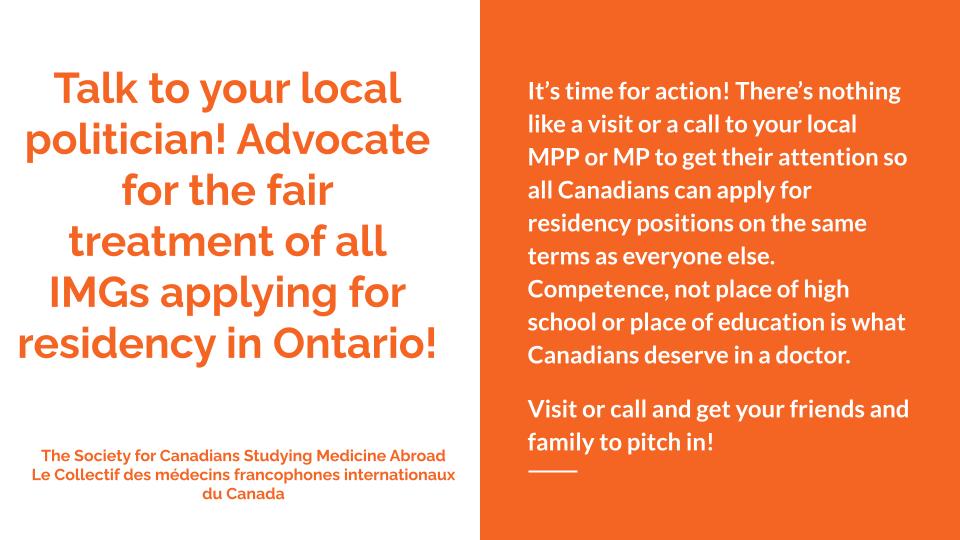
Many Ontario Residency Program Directors are expressing that they value diversity, are not in agreement with, and do not support, the Ontario government’s recent changes to the CaRMS eligibility criteria. They believe “A Canadian is a Canadian” and want to choose the most qualified candidates for their program regardless of where they attended high school or medical school.
We invite Ontario residency programs to act in solidarity with each other to protest inequitable Match policy by agreeing to select NO candidates from the first iteration so ALL candidates are moved to the open second iteration where ALL can compete on an equal basis.
Show with this action that Ontario Post Graduate Medical Education values diversity and equity!
Society of Canadians Studying Medicine Abroad (SOCASMA)
Rosemary Pawliuk, President
and Dr. Laura Blew, Board member and Ontario Family Physican
Internationally Trained Physicians of Canada ( ITPC)
Le Collectif des médecins francophones internationaux du Canada
Canadian On Paper Society of Immigrant Physicians Equality (COPSIPE)
The Foundation of International Medical Graduates
————————————————————————————————————————-
Traduction
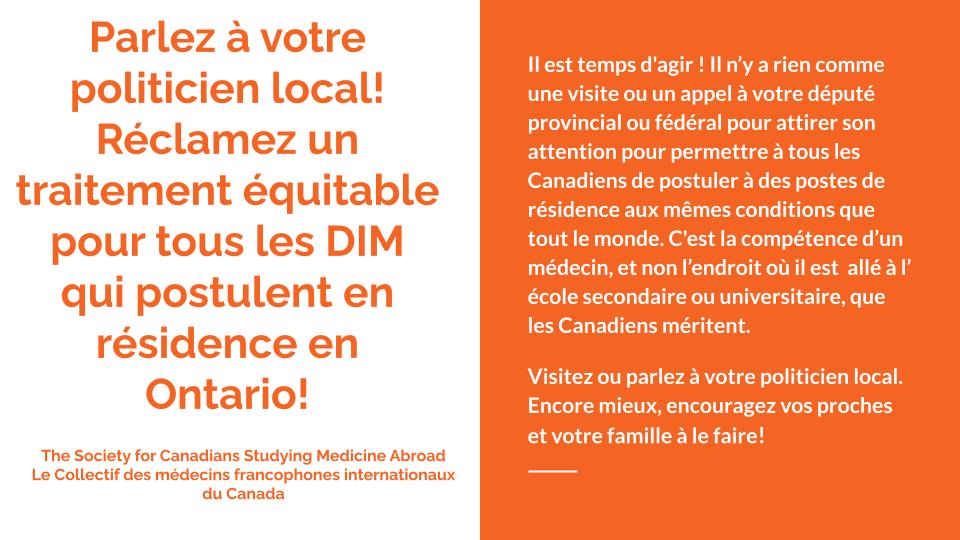
De nombreux directeurs de programmes de résidence de l’Ontario expriment leur attachement à la diversité, leur désaccord avec les récentes modifications apportées par le gouvernement de l’Ontario aux critères d’admissibilité du CaRMS et leur refus de les soutenir. Ils croient qu’« un Canadien est un Canadien » et souhaitent sélectionner les candidats les plus qualifiés pour leur programme, peu importe où ils ont fait leurs études secondaires ou leur faculté de médecine.
Nous invitons les programmes de résidence de l’Ontario à manifester leur solidarité pour protester contre la politique inéquitable de jumelage en acceptant de ne sélectionner AUCUN candidat lors du premier tour afin que TOUS les candidats soient transférés au deuxième tour, ouvert à tous, où TOUS peuvent concourir sur un pied d’égalité.
Montrez par cette action que le programme d’études médicales postdoctorales de l’Ontario valorise la diversité et l’équité !
Society of Canadians Studying Medicine Abroad (SOCASMA)
Rosemary Pawliuk, Présidente
et Dr. Laura Blew, membre du Conseil d’administration et médecin de famille en Ontario
Internationally Trained Physicians of Canada ( ITPC)
Le Collectif des médecins francophones internationaux du Canada
Canadian On Paper Society of Immigrant Physicians Equality (COPSIPE)